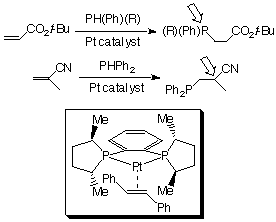
19. "Pt(Me-Duphos)-Catalyzed Asymmetric Hydrophosphination of Activated Olefins: Enantioselective Synthesis of Chiral Phosphines," Ivan Kovacik, Denyce K. Wicht, Navrose S. Grewal, David S. Glueck, Christopher D. Incarvito, Ilia A. Guzei, and Arnold L. Rheingold, Organometallics 2000, 19, 950-953.
Treatment of Pt(R,R-Me-Duphos)(trans-stilbene) (1) with PH(Ph)(Is) (Is = 2,4,6-(i-Pr)3C6H2) gave Pt(Me-Duphos)[P(Ph)(Is)](H) (2), which underwent diastereoselective insertion of acrylonitrile into the Pt-P bond to give a mixture of four alkyl hydrides Pt(Me-Duphos)[CH(CN)CH2P(Ph)(Is)](H) (3). Subsequent reductive elimination in the presence of acrylonitrile gave the P-chiral tertiary phosphine P(Ph)(Is)(CH2CH2CN) (4) in 63-71% enantiomeric excess (ee) and Pt(Me-Duphos)(CH2CHCN) (5). Complex 1 was used as a catalyst precursor for asymmetric hydrophosphination of acrylonitrile, t-butyl acrylate, and related substrates to give tertiary phosphines in low ee. These results demonstrate that Pt-catalyzed asymmetric hydrophosphination can be used to control stereochemistry at phosphorus or at carbon centers.