17. "Chiral Terminal Platinum(II) Phosphido Complexes: Synthesis, Phosphorus Inversion, and Acrylonitrile Insertion," Denyce K. Wicht, Ivan Kovacik, David S. Glueck, Louise M. Liable-Sands, Christopher D. Incarvito, and Arnold L. Rheingold, Organometallics 1999,18, 5141-5151.
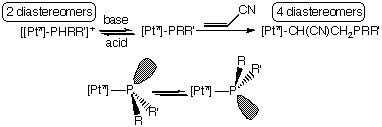
The chiral Pt(II) phosphido complex Pt(dppe)(Me)[P(Mes)(Men)] (dppe = Ph2PCH2CH2PPh2, Mes = 2,4,6-Me3C6H2, Men = (-)Menthyl, 1) was prepared by proton transfer from racemic mesityl(&endash;)menthylphosphine to the methoxide ligand of Pt(dppe)(Me)(OMe). Treatment of Pt(dcpe)[CH(Me)(CN)](Br) with alkali metal phosphides gives Pt(dcpe)[CH(Me)(CN)](PRR') (dcpe = Cy2PCH2CH2PCy2, Cy = cyclo-C6H11, R = H, R' = Mes* = 2,4,6-(t-Bu)3C6H2, 13; R = Me, R' = Ph, 14). The related series of complexes Pt(diphos*)(Me)(PRR') (diphos* = S,S-Chiraphos, R = Ph, R' = Is = 2,4,6-(i-Pr)3C6H2), 5; R = Me, R' = Mes*, 6; diphos* = R-Tol-Binap, R = Me, R' = Mes*, 7) containing chiral diphosphine ligands has been prepared by deprotonation of the cations [Pt(diphos*)(Me)(PHRR')][BF4] 2, 3, and 4 respectively. The cations, synthesized from Pt(diphos*)(Me)(Cl), AgBF4, and the appropriate secondary phosphine, were isolated as a mixture of diastereomers (2 and 3) or a single isomer (4).
Phosphido complexes 1 and 5-7 show only one set of 31P NMR resonances in solution even at low temperature, consistent either with the existence of a single diastereomer or with rapid inversion at phosphorus. However, low-temperature spectra of 13 and 14 reveal the existence of the expected two diastereomers, which interconvert by phosphorus inversion and rotation about the Pt-P bond with barriers of approximately 11.5 and 15.5 kcal/mol, respectively. Treatment of 6 and 7 with HBF4 protonates the phosphido ligand and generates diastereomeric mixtures of the cations 3 and 4, respectively. Acrylonitrile inserts into the Pt-P bond of 1 to give the dialkyl complex Pt(dppe)(Me)[CH(CN)CH2P(Mes)(Men)] (9) as a mixture of four diastereomers; similar product mixtures (10-12) are obtained with 5-7. Complexes 4·3CH2Cl2, 5, and the secondary phosphine PH(Me)(Mes*) (8) were structurally characterized by X-ray crystallography.