7. "Phosphaazaallene Dimerization and Phosphaallene Isomerization: Catalysis by Zerovalent Palladium and Platinum Complexes," Marie-Anne David, John B. Alexander, David S. Glueck, Glenn P. A. Yap, Louise M. Liable-Sands, and Arnold L. Rheingold, Organometallics 1997, 16, 378-383.
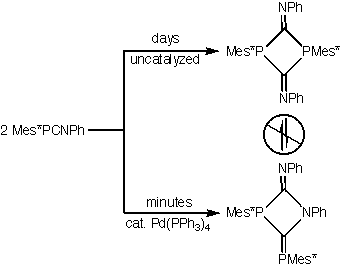
Several Pd(0) complexes catalyze the dimerization of Mes*PCNPh [2, Mes* = 2,4,6-(t-Bu)3C6H2] to the unsymmetrical heterocycle Mes*P(µ-CNPh)NPh(µ-CPMes*) (5). The symmetrical dimer [Mes*P(µ-CNPh)]2 (7), which forms slowly by uncatalyzed dimerization of 2, does not interconvert with 5; both 5 and 7 were structurally characterized by X-ray crystallography. The Pt complexes PtL2[h2-(P,C)-Mes*PCNPh] [8, L = 1/2 dppe (Ph2PCH2CH2PPh2); 9, L = PPh3; 10, L = PCy3 (Cy = cyclo-C6H11)], models for intermediates in the catalysis, were prepared. Isomerization of Mes*PCCPh2 (3) to the phosphaindan [2,4-(t-Bu)2C6H2(6-CMe2CH2PCH=CPh2)] (6), which we previously observed with Rh(I) catalysts, is catalyzed by Pt(PCy3) 2 or the known Pt(PPh3)2[h2-(P,C)-Mes*PCCPh2] (12). Comparison of the metal-mediated reactions of 2 and 3 suggests that the initial steps in the catalyses, coordination of the phosphacumulene to M(0), followed by loss of a ligand, are similar.