76. Gibbons,
S. K.; Valleau, C. R. D.; Peltier, J. L.; Cain,
M. F.; Hughes, R. P.; Glueck, D. S.; Golen, J.
A.; Rheingold, A. L. Diastereoselective
Coordination of P-Stereogenic Secondary
Phosphines in Copper(I) Chiral Bis(phosphine)
Complexes: Structure, Dynamics, and Generation
of Phosphido Complexes. Inorg. Chem.2019,
58, 8854-8865.
Abstract
Diastereoselective
coordination of racemic secondary phosphines (PHRR′) to Cu(I)
precursors containing chiral bis(phosphines) (diphos*) was
explored as a potential route to P-stereogenic phosphido
complexes. Reaction of [Cu(NCMe)4][PF6]
with chiral bis(phospholanes) gave [Cu(diphos*)2][PF6]
(diphos* = (R,R)-Me-DuPhos (1), (R,R)-Et-DuPhos
(2), or (R,R)-Me-FerroLANE) (3)) or
the mono(chelates) [Cu(diphos*)(NCMe)n][PF6]
(diphos* = (R,R)-i-Pr-DuPhos, n = 2
(4); diphos* = (R,R)-Me-FerroLANE, n
= 1 (5)). Treatment of [Cu(NCMe)4][PF6]
with diphos* and PHMe(Is) (Is = 2,4,6-(i-Pr)3C6H2)
gave mixtures of diastereomers of [Cu((R,R)-i-Pr-DuPhos)(PHMe(Is))(NCMe)][PF6]
(6) and [Cu((R,R)-Me-FerroLANE)(PHMe(Is))][PF6]
(7); two of the three expected isomers of the
bis(secondary phosphine) complexes [Cu((R,R)-i-Pr-DuPhos)(PhHP(CH2)nPHPh)][PF6]
(n = 2 (8); n = 3 (9)) were formed
preferentially in related reactions. Reaction of the
halide-bridged dimers [Cu((R,R)-i-Pr-DuPhos)(X)]2
or [Cu((R,R)-Me-FerroLANE)(I)]2 with
PHMe(Is) gave the labile adducts Cu((R,R)-i-Pr-DuPhos)(PHMe(Is))(X)
(X = Cl (10), Br (11), I (12)) and Cu((R,R)-Me-FerroLANE)(PHMe(Is))(I)
(13). Complexes 1, 6, and 8–11
were structurally characterized by X-ray crystallography.
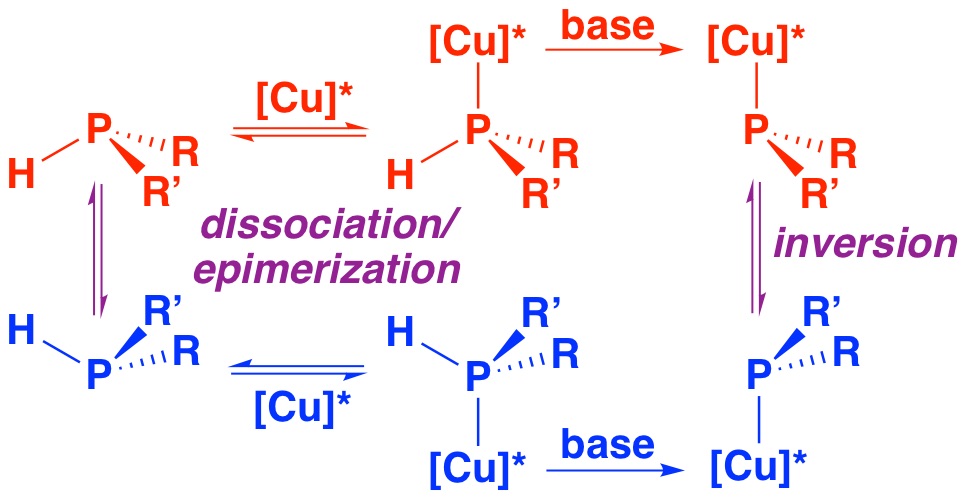
Variable temperature NMR studies of 6 and 8
showed that the secondary phosphine ligands underwent reversible
dissociation. Deprotonation of 6 or 7 generated
the P-stereogenic phosphido complexes Cu(diphos*)(PMeIs)
(diphos* = (R,R)-i-Pr-DuPhos (14) or
(R,R)-Me-FerroLANE) (17)), observed by 31P
NMR spectroscopy, but decomposition also occurred. Density
functional theory calculations were used to characterize the
diastereomers of thermally unstable 17 and the inversion
barrier in a model copper-phosphido complex. These observations
provided structure–property relationships which may be useful in
developing catalytic asymmetric reactions involving secondary
phosphines and P-stereogenic copper phosphido intermediates.